has been added to your cart




Every November 21, Ukraine marks ДЕНЬ ГІДНОСТІ ТА СВОБОДИ (Day of Dignity and Freedom), remembering two defining events in its modern history: the Orange Revolution of 2004 and the Revolution of Dignity of 2013–2014.
Both revolutions brought hundreds of thousands of Ukrainians into the streets to defend their rights and their country’s future.
The Orange Revolution and the Revolution of Dignity are closely connected chapters in Ukraine’s long struggle for freedom and democracy. Both tested Ukrainian society and showed that defending freedom requires continued effort. Their lessons remain especially relevant today, as Ukrainians continue to fight for their country’s future against Russia’s aggression.
The symbols of Ukraine’s revolutions offer a fascinating way to revisit this history. Let’s explore 15 everyday objects and notions that took on special meaning during the protests, learn their Ukrainian names, and discover the stories behind them, with photographs and audio to help you practice.
ПОМАРАНЧЕВА РЕВОЛЮЦІЯ began in November 2004, following a presidential election marked by widespread fraud in favor of Viktor Yanukovych, the government-backed candidate.
Hundreds of thousands of Ukrainians gathered in Kyiv and other cities across the country, demanding fair elections and supporting the opposition candidate, Viktor Yushchenko. The demonstrations remained largely peaceful, with music, speeches, and a vast volunteer effort helping protesters endure the freezing temperatures and sustain the rallies for weeks.
Want to learn more about Ukraine’s recent history? In Episode 79 of the Ukrainian Lessons Podcast, explore independent Ukraine, its first presidents, and both revolutions while practicing your Ukrainian listening skills.
The movement became known as the Orange Revolution, named after Yushchenko’s campaign color. After weeks of mass protests, investigations into electoral fraud, and legal challenges, Ukraine’s Supreme Court invalidated the disputed election results and ordered a repeat of the second-round vote, which Yushchenko won.
Let’s explore some of the most recognizable symbols of the Orange Revolution and the stories behind them.
A small orange СТРІЧКА became one of the simplest ways to show support for the Orange Revolution.
People attached ribbons to their coats, bags, car antennas, and practically anything else they could find. These ribbons became a widely recognized symbol of support for fair elections and democratic change.
November and December can be bitterly cold in Kyiv, so warm clothes were essential for protesters who spent long hours outdoors.
During the Orange Revolution, an orange ШАРФ became a political statement. Thousands wore orange scarves, hats, and other accessories, often featuring campaign slogans or Yushchenko’s name.
Want to learn more clothing vocabulary? Practice одяг і взуття (clothes and shoes) in Ukrainian with our flashcards and video exercises!
For weeks, the center of Kyiv was home to a large tent camp, or НАМЕТОВЕ МІСТЕЧКО.
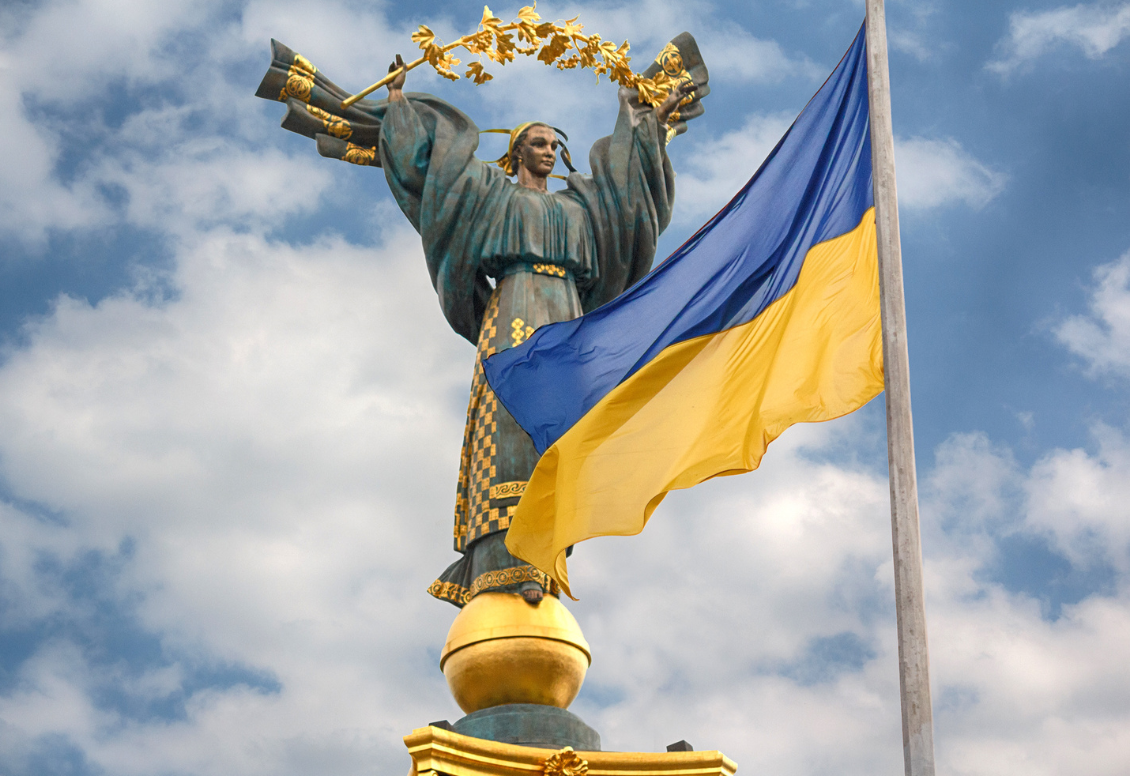
Protesters set up tents on Kyiv’s main square — МАЙДАН НЕЗАЛЕЖНОСТІ (Independence Square). Many stayed overnight despite freezing temperatures, relying on volunteers who brought food, warm clothes, and other necessities.
One of the most recognizable imageries of the Orange Revolution was a bright orange ПЛАКАТ featuring a single Ukrainian word: ТАК! (Yes!)
It was the main slogan of Viktor Yushchenko’s presidential campaign, appearing on posters, flags, and other campaign materials.
РАЗОМ НАС БАГАТО, НАС НЕ ПОДОЛАТИ! (Together we are many, we cannot be defeated!) — this is a famous ГАСЛО (slogan) of the Orange Revolution.
It was shouted at rallies and popularized by the Ukrainian hip-hop band ГРИНДЖОЛИ (GreenJolly), whose song became an unofficial anthem of the revolution.
Music played an important role in keeping up protesters’ spirits, with many Ukrainian celebrities openly supporting the rallies, including the hugely popular rock band Okean Elzy, which performed for the crowds on Maidan.
Discover a song by Okean Elzy “Я їду додому” (I’m Going Home), with Ukrainian lyrics and English translations to help you learn through music!
Nine years later, Ukrainians returned to Independence Square to protest. РЕВОЛЮЦІЯ ГІДНОСТІ began on November 21, 2013, after President Viktor Yanukovych’s government suspended preparations to sign an association agreement with the European Union.
The first demonstrations, known as ЄВРОМАЙДАН (Euromaidan), called for closer ties with Europe. When riot police violently dispersed peaceful protesters, many of them young students, the protests expanded into a nationwide movement against government violence, corruption, and abuses of power.
Over the following months, the confrontation became increasingly dangerous. In January and February 2014, violent clashes erupted between protesters and security forces. More than a hundred people lost their lives during the revolution.
The events of that winter left a lasting mark on Ukrainian society, and the objects associated with them remain important reminders of both the protest movement and its human cost.
Гідність (dignity) is one of many powerful Ukrainian words that have taken on special meaning. Discover 15 words that define Ukraine today, with audio and a short grammar lesson!
The EU flag appeared alongside the Ukrainian national flag from the first days of Euromaidan.
For many protesters, it represented Ukraine’s European aspirations and the opportunity to build a future based on democratic values, with closer ties to European countries.
As the demonstrations grew, the flag also came to symbolize Ukrainians’ determination to choose their country’s future independently, without external pressure, particularly from Russia.
Musicians brought pianos into the streets and performed, sometimes directly in front of lines of riot police.
The performances became memorable examples of peaceful protest and the creativity of the Maidan movement. Even during tense confrontations, music remained an important part of life on the square.
Do you know the Ukrainian names of musical instruments? Explore our illustrated vocabulary collection with audio to practice their pronunciation!
As confrontations with police became more frequent, protesters began wearing construction КАСКИ to protect themselves from injuries.
Many of these helmets were decorated with Ukrainian flags, tridents, flowers, or religious symbols. Artists and volunteers painted them for protesters, giving each one a personal appearance.
Although ordinary construction helmets offered little protection against serious weapons, they became recognizable symbols of Maidan’s self-defense movement.
Members of the Maidan self-defense groups used improvised shields made from wood, metal, and other available materials to protect themselves during confrontations with security forces.
Some shields were decorated with Ukraine’s national emblem, religious icons, or personal messages. Several of these original objects have since been preserved in museum collections, where their inscriptions tell stories about the people who carried them.
During the winter of 2013–2014, БАРИКАДИ transformed the appearance of central Kyiv.
Protesters constructed them using wooden pallets, bags filled with snow, car tires, and other materials. They were intended to prevent security forces from entering the protest camp and dispersing demonstrators.
As confrontations intensified, the barricades grew larger and more elaborate. They became prominent features of Maidan.
Few images of the Revolution of Dignity are as recognizable as the thick black smoke rising from burning car tires.
During violent clashes with security forces in January 2014, protesters set tires on fire to create smoke screens and reinforce barricades.
As clashes between protesters and police intensified, some demonstrators began using improvised incendiary weapons known as КОКТЕЙЛЬ МОЛОТОВА (Molotov cocktail).
They were used during violent confrontations in January and February 2014, as protesters faced riot police armed with stun grenades, tear gas, water cannons, and eventually live ammunition.
Molotov cocktails became one of the most recognizable symbols of the revolution’s increasingly violent confrontations.
One of the most unusual and darkly humorous symbols of the Revolution of Dignity appeared in January 2014.
On January 16, Ukraine’s parliament adopted a series of restrictive laws aimed at suppressing protests. Among other measures, the legislation prohibited demonstrators from wearing protective helmets.
In response, some protesters appeared in the streets wearing ordinary kitchen КАСТРУЛІ (cooking pots) and ДРУШЛЯКИ (colanders) on their heads.
The improvised headgear openly mocked the new restrictions, turning them into symbols of defiance.
Explore посуд (tableware) with our illustrated word list and audio, and practice the names of common items used at the table.
When riot police violently dispersed peaceful protesters on November 30, 2013, МИХАЙЛІВСЬКИЙ ЗОЛОТОВЕРХИЙ МОНАСТИР (St. Michael’s Golden-Domed Monastery) opened its doors to those fleeing the violence, providing shelter. Throughout the revolution, the monastery remained an important refuge for injured protesters.
On the night of December 10–11, 2013, when security forces attempted another assault on Independence Square, the monastery’s ДЗВОНИ (bells) rang out across central Kyiv, warning residents of the danger.
St. Michael’s Monastery played an extraordinary role throughout the revolution, offering practical help and safety to thousands of people during some of its most difficult moments.
You can watch this Ukrainian TV report recalling the historic night when the bells of St. Michael’s helped save Maidan.
More than a hundred people were killed, many of them during the deadly confrontations of February 2014. Those who died became known collectively as НЕБЕСНА СОТНЯ (Heavenly Hundred).
To honor the fallen, Ukrainians lit СВІЧКИ and laid flowers beside their photographs on Maidan, turning parts of the square into places of remembrance.
Today, lighting candles remains an important tradition during commemorations of the Revolution of Dignity. Every year, Ukrainians gather to remember the Heavenly Hundred and the sacrifices made in the struggle for freedom and dignity.
***
Want to learn more about Ukraine’s past?
Explore our Ukrainian History Course, which introduces important events and figures through accessible audio Ukrainian lessons and discover the history and meaning of Ukrainian national symbols with vocabulary and audio.